Sports Playbooks are Just an Algorithm
In this activity, students will discover how sports playbooks are just algorithms. Starting with the hockey playbook play, “The Flying V,” from the Disney movie “The Mighty Ducks” students will discuss the connection to computer science concepts like decomposition, algorithms, and conditional statements. After breaking down the exemplar play, students apply what they’ve learned to create and describe their own sports play, connecting teamwork strategies to programming principles.
This activity is best integrated into lessons on algorithms, problem-solving, or computational thinking in computer science or STEM classes. It also works well as a cross-curricular activity with physical education, or before a major sporting event such as March Madness or the Super Bowl, allowing students to explore the connection between teamwork, strategy, and logical thinking.
To set the stage, this activity uses a short video to level set prior knowledge with a class. After the 30 second video, it is an unplugged activity for teachers to use to reinforce abstract concepts with a fun, real-world application.
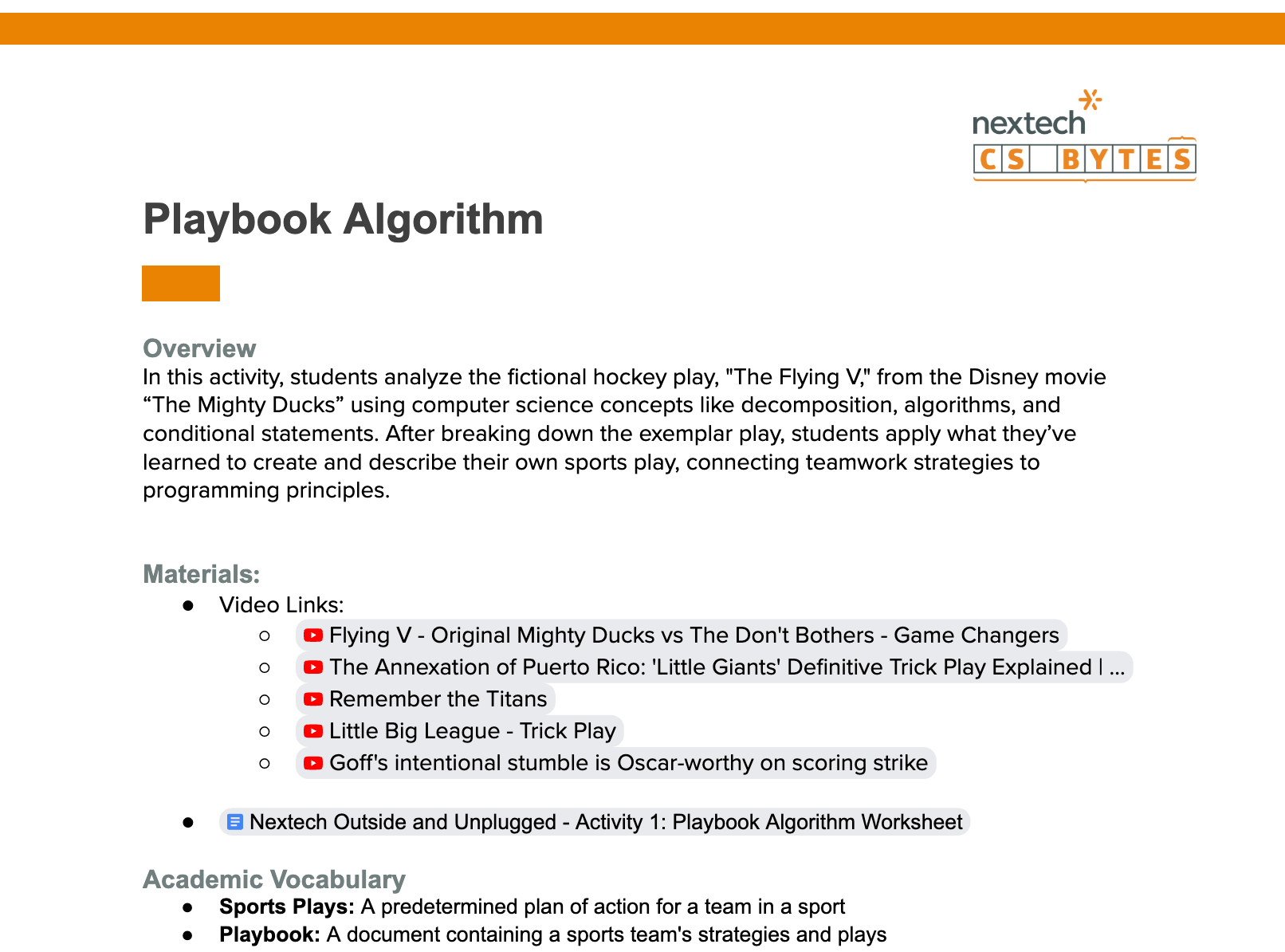
Materials
-
Lesson Plan Playbook Algorithm
https://docs.google.com/document/d/1RTN0Ca4jfGgXbhDE0qJ93p-vuuYxcJfk1nlc_Yc15gs/edit?usp=drive_link -
Playbook Algorithm Worksheet
https://docs.google.com/document/d/1fwa0p9CVNea-pJEcALIEpdrbw-8x6w9FKHsN-mIb1ng/edit?usp=drive_link
Tips for Running Activity
This lesson is developed as a “we do, you do” activity. Together as a “we do” the class can follow through the play “the Flying V” from the Disney movie, “The Mighty Ducks.” This second part of the activity does require video, as a minimal plugged component. Depending on the sports knowledge of your classroom the video components may or may not be necessary.
- Begin class with an open discussion to determine their prior knowledge regarding sports, sports plays, hockey, and/or who has watched the movie “The Mighty Ducks.”
- Introduce the activity and walk through the worksheet with the students as it applies to the Flying V.
- For student success consider chunking the activity into smaller sections, and/or release worksheet pages one at a time.
- Here are some sentence starters for students who need extra help or direction making their plays:
- “The goal of this play is to…”
- “To start the play, the team will…”
- “The player with the ball should…”
- “While the ball carrier moves, the rest of the team will…”
- “If the other team tries to stop us, we can…”
- “This play works best when we…”
- “A special trick in this play is to…”
- “To finish the play, the ball carrier should…”
- “The most important thing about this play is to…”
Vocabulary:
- Sports Plays: a predetermined plan of action for a team in a sport
- Playbook: a book containing a sports team’s strategies and plays
- Decomposition: Break the play into smaller steps or actions.
- Pattern Recognition (Loops): Identify repeating actions or movements.
- Abstraction: Focus on the critical steps and ignore less important details.
- Algorithms: Write the play as a sequence of instructions that can be followed.
This lesson is developed as a “we do, you do” activity. Together as a “we do” the class can follow through the play “the Flying V” from the Disney movie, “The Mighty Ducks.” This second part of the activity does require video, as a minimal plugged component. Depending on the sports knowledge of your classroom the video components may or may not be necessary.
- Begin class with an open discussion to determine their prior knowledge regarding sports, sports plays, hockey, and/or who has watched the movie “The Mighty Ducks.”
- Introduce the activity and walk through the worksheet with the students as it applies to the Flying V.
- For student success consider chunking the activity into smaller sections, and/or release worksheet pages one at a time.
- Here are some sentence starters for students who need extra help or direction making their plays:
- “The goal of this play is to…”
- “To start the play, the team will…”
- “The player with the ball should…”
- “While the ball carrier moves, the rest of the team will…”
- “If the other team tries to stop us, we can…”
- “This play works best when we…”
- “A special trick in this play is to…”
- “To finish the play, the ball carrier should…”
- “The most important thing about this play is to…”
Vocabulary:
- Sports Plays: a predetermined plan of action for a team in a sport
- Playbook: a book containing a sports team’s strategies and plays
- Decomposition: Break the play into smaller steps or actions.
- Pattern Recognition (Loops): Identify repeating actions or movements.
- Abstraction: Focus on the critical steps and ignore less important details.
- Algorithms: Write the play as a sequence of instructions that can be followed.
This lesson is developed as a “we do, you do” activity. Together as a “we do” the class can follow through the play “the Flying V” from the Disney movie, “The Mighty Ducks.” This second part of the activity does require video, as a minimal plugged component. Depending on the sports knowledge of your classroom the video components may or may not be necessary.
- Begin class with an open discussion to determine their prior knowledge regarding sports, sports plays, hockey, and/or who has watched the movie “The Mighty Ducks.”
- Introduce the activity and walk through the worksheet with the students as it applies to the Flying V.
- For student success consider chunking the activity into smaller sections, and/or release worksheet pages one at a time.
- Here are some sentence starters for students who need extra help or direction making their plays:
- “The goal of this play is to…”
- “To start the play, the team will…”
- “The player with the ball should…”
- “While the ball carrier moves, the rest of the team will…”
- “If the other team tries to stop us, we can…”
- “This play works best when we…”
- “A special trick in this play is to…”
- “To finish the play, the ball carrier should…”
- “The most important thing about this play is to…”
Vocabulary:
- Sports Plays: a predetermined plan of action for a team in a sport
- Playbook: a book containing a sports team’s strategies and plays
- Decomposition: Break the play into smaller steps or actions.
- Pattern Recognition (Loops): Identify repeating actions or movements.
- Abstraction: Focus on the critical steps and ignore less important details.
- Algorithms: Write the play as a sequence of instructions that can be followed.
Assessment Opportunities
- Take playbook plays outside and practice running them!
- Give the plays to a local coach and get “industry” feedback
- Use arrows and chalk to draw plays on the playground.
- Use items within the playbook student worksheet such as reflection questions, algorithm design, etc. as assessment opportunities.
- Take playbook plays outside and practice running them!
- Give the plays to a local coach and get “industry” feedback
- Use arrows and chalk to draw plays on the playground.
- Use items within the playbook student worksheet such as reflection questions, algorithm design, etc. as assessment opportunities.
- Take playbook plays outside and practice running them!
- Give the plays to a local coach and get “industry” feedback
- Use arrows and chalk to draw plays on the playground.
- Use items within the playbook student worksheet such as reflection questions, algorithm design, etc. as assessment opportunities.
Extension / Assessment Opportunities
- Take playbook plays outside and practice running them!
- Give the plays to a local coach and get “industry” feedback
- Take playbook plays outside and practice running them!
- Give the plays to a local coach and get “industry” feedback
- Take playbook plays outside and practice running them!
- Give the plays to a local coach and get “industry” feedback