ELA and Data Science
Materials
-
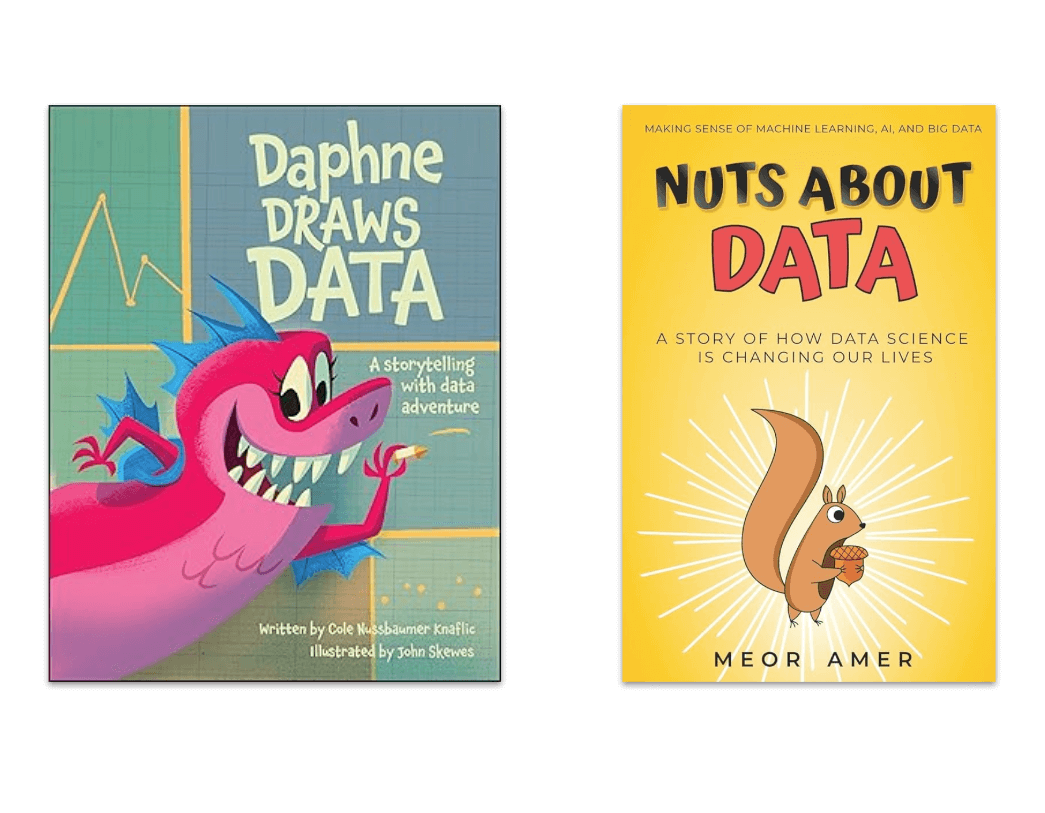
Daphne Draws Data - Book
https://www.daphnedrawsdata.com/order -
Daphne Draws Data - Educator Resource Page
https://www.daphnedrawsdata.com/educators -
Daphne Draws Data - Educator Guide
https://docs.google.com/document/d/1VgEK2dNg25vBc4iZ7cm7_QfCcHsXVt34naIiLO2j_0E/edit?tab=t.0#heading=h.d88tsu7sekgd -
Nuts About Data - Book (Amazon non-affiliate link)
https://www.amazon.com/Nuts-About-Data-Science-Changing/dp/9671727204
Main Lesson Plan
- Warm-up and vocabulary introduction
- Begin with asking students “When I say the word DATA, what do you think of? What are different types of DATA?”
- Introduce the vocabulary:
- Data: (noun) All information stored and processed by a computing device is referred to as data. Data can be images, text documents, audio files, software programs or apps, video files, etc.
- Read Your Story (either as a read-aloud or independently)
- For K-5 students, read Daphne Draws Data by Cole Nussbaumer Knaflic as a read-aloud
- Use any and all of the resources from the Daphne Draws Data Educator Guide which includes:
- Book Overview
- Educational Goals
- Discussion questions & activities (for each grade Kindergarten through 4th grade)
- Mapping onto the Common Core Standards
- Additional resource
- For 4-12 students, have students read Nuts About Data (either as chapter read-alouds or independently)
- Have students gather all relevant information about data, data gathering, data cleansing, and data analyzing as they read the book.
- Discuss What Data Is after the Story
- Ask, “What did this story teach us about DATA?”
- You can have the students collect data from the books itself, graph the data, and present their findings OR they can collect alternative data that they (or you) pick, to sort, graph and present.
- Warm-up and vocabulary introduction
- Begin with asking students “When I say the word DATA, what do you think of? What are different types of DATA?”
- Introduce the vocabulary:
- Data: (noun) All information stored and processed by a computing device is referred to as data. Data can be images, text documents, audio files, software programs or apps, video files, etc.
- Read Your Story (either as a read-aloud or independently)
- For K-5 students, read Daphne Draws Data by Cole Nussbaumer Knaflic as a read-aloud
- Use any and all of the resources from the Daphne Draws Data Educator Guide which includes:
- Book Overview
- Educational Goals
- Discussion questions & activities (for each grade Kindergarten through 4th grade)
- Mapping onto the Common Core Standards
- Additional resource
- For 4-12 students, have students read Nuts About Data (either as chapter read-alouds or independently)
- Have students gather all relevant information about data, data gathering, data cleansing, and data analyzing as they read the book.
- Discuss What Data Is after the Story
- Ask, “What did this story teach us about DATA?”
- You can have the students collect data from the books itself, graph the data, and present their findings OR they can collect alternative data that they (or you) pick, to sort, graph and present.
- Warm-up and vocabulary introduction
- Begin with asking students “When I say the word DATA, what do you think of? What are different types of DATA?”
- Introduce the vocabulary:
- Data: (noun) All information stored and processed by a computing device is referred to as data. Data can be images, text documents, audio files, software programs or apps, video files, etc.
- Read Your Story (either as a read-aloud or independently)
- For K-5 students, read Daphne Draws Data by Cole Nussbaumer Knaflic as a read-aloud
- Use any and all of the resources from the Daphne Draws Data Educator Guide which includes:
- Book Overview
- Educational Goals
- Discussion questions & activities (for each grade Kindergarten through 4th grade)
- Mapping onto the Common Core Standards
- Additional resource
- For 4-12 students, have students read Nuts About Data (either as chapter read-alouds or independently)
- Have students gather all relevant information about data, data gathering, data cleansing, and data analyzing as they read the book.
- Discuss What Data Is after the Story
- Ask, “What did this story teach us about DATA?”
- You can have the students collect data from the books itself, graph the data, and present their findings OR they can collect alternative data that they (or you) pick, to sort, graph and present.
Tips for Running Activity
Once students are familiar with the concept of data, you can have them collect data from any and all stories.
Once students are familiar with the concept of data, you can have them collect data from any and all stories.
Once students are familiar with the concept of data, you can have them collect data from any and all stories.
Assessment Opportunities:
The Daphne Draws Data Educator Guide has a ton of great activities and opportunities for assessments.
The Daphne Draws Data Educator Guide has a ton of great activities and opportunities for assessments.
The Daphne Draws Data Educator Guide has a ton of great activities and opportunities for assessments.
Extension Opportunities
- For older students, you can get them working with Google sheet or excel to start working with and manipulating data. They can even create their own Google forms to collect the data.
- Constantly bringing Data Science and it’s terminology into every time you collect, clean, analyze and present data will go a long way for students understanding that Data Science is in everything they do.
- For older students, you can get them working with Google sheet or excel to start working with and manipulating data. They can even create their own Google forms to collect the data.
- Constantly bringing Data Science and it’s terminology into every time you collect, clean, analyze and present data will go a long way for students understanding that Data Science is in everything they do.
- For older students, you can get them working with Google sheet or excel to start working with and manipulating data. They can even create their own Google forms to collect the data.
- Constantly bringing Data Science and it’s terminology into every time you collect, clean, analyze and present data will go a long way for students understanding that Data Science is in everything they do.