CS & AI Vocabulary Review Checkers
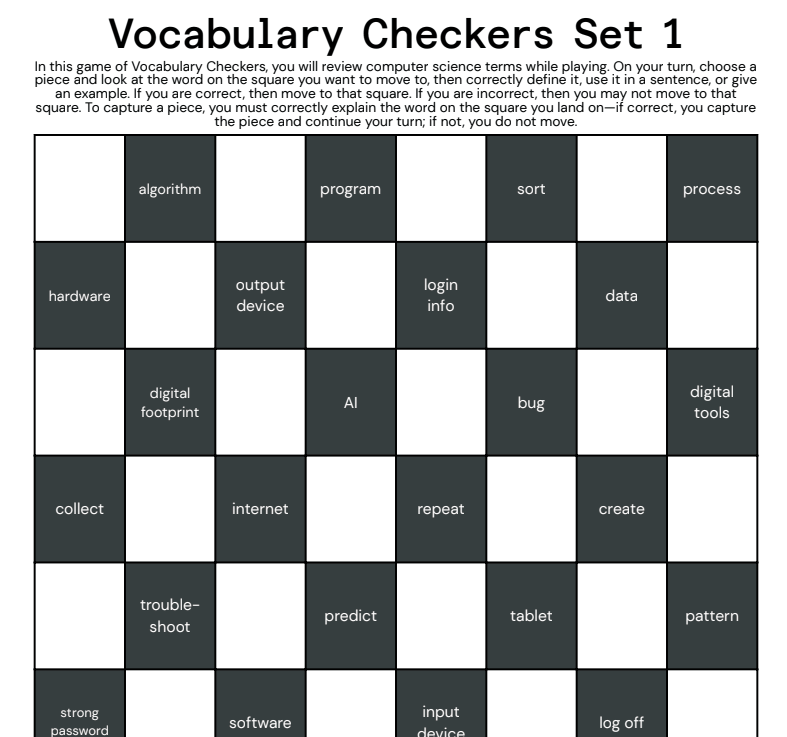
This game of Vocabulary Checkers adds a fun spin on traditional checkers by combining strategy with vocabulary review. As students play, they reinforce computer science and AI terms through this fun and interactive game.
How to Play: On your turn, choose a piece and look at the word on the square you want to move to. You must correctly define the term, use it in a sentence, or give an example. If correct, move to that square; if not, you lose your turn. To capture a piece, you must also correctly explain the word on the landing square. If correct, capture the piece and continue your turn; if not, you do not move.
Materials
-
K-2 Vocabulary Review Checkers
https://drive.google.com/file/d/1Tc-vc99sPEQLSve9jbiH6VT9IxQusp2r/view?usp=drive_link -
3-5 Vocabulary Review Checkers
https://drive.google.com/file/d/1qppDMUryrQlHde_265n7tSwUZ5BGxo-E/view?usp=drive_link -
6-8 Vocabulary Review Checkers
https://drive.google.com/file/d/1UqVWGm2icVi5eS7hFRkKHQo3_wg9A3Zg/view?usp=drive_link -
AI Vocabulary Review Checkers
-
Create Your Own Vocabulary Review Checkers
https://drive.google.com/file/d/1p7dAU6ILjAbLavKh2S1c0djL2dMWfkaq/view?usp=drive_link
Activity Instructions
This Vocabulary Checkers resource includes four vocabulary sets designed to support a range of learners. Sets 1–3 scaffold in difficulty, allowing you to match gameplay to your students’ current level or use the sets together for a more rigorous review.
- Set 1 (K–2): Foundational computer science terms aligned to the IDOE K–2 academic word wall
- Set 2 (3–5): Intermediate computer science vocabulary
- Set 3 (6–8): More advanced computer science terms
- AI Set: Artificial intelligence-focused vocabulary that can be used alongside any level
- Create Your Own Set: a blank template for you, or your students, to write in your own vocabulary terms
Teachers may choose a single set that best fits their students’ needs or combine multiple sets to increase challenge and differentiation. For an added level of rigor and engagement, consider mixing all sets together to create a comprehensive review experience. While there is some overlap across sets, the vocabulary is intentionally scaffolded to build understanding and deepen student knowledge over time.
This Vocabulary Checkers resource includes four vocabulary sets designed to support a range of learners. Sets 1–3 scaffold in difficulty, allowing you to match gameplay to your students’ current level or use the sets together for a more rigorous review.
- Set 1 (K–2): Foundational computer science terms aligned to the IDOE K–2 academic word wall
- Set 2 (3–5): Intermediate computer science vocabulary
- Set 3 (6–8): More advanced computer science terms
- AI Set: Artificial intelligence-focused vocabulary that can be used alongside any level
- Create Your Own Set: a blank template for you, or your students, to write in your own vocabulary terms
Teachers may choose a single set that best fits their students’ needs or combine multiple sets to increase challenge and differentiation. For an added level of rigor and engagement, consider mixing all sets together to create a comprehensive review experience. While there is some overlap across sets, the vocabulary is intentionally scaffolded to build understanding and deepen student knowledge over time.
This Vocabulary Checkers resource includes four vocabulary sets designed to support a range of learners. Sets 1–3 scaffold in difficulty, allowing you to match gameplay to your students’ current level or use the sets together for a more rigorous review.
- Set 1 (K–2): Foundational computer science terms aligned to the IDOE K–2 academic word wall
- Set 2 (3–5): Intermediate computer science vocabulary
- Set 3 (6–8): More advanced computer science terms
- AI Set: Artificial intelligence-focused vocabulary that can be used alongside any level
- Create Your Own Set: a blank template for you, or your students, to write in your own vocabulary terms
Teachers may choose a single set that best fits their students’ needs or combine multiple sets to increase challenge and differentiation. For an added level of rigor and engagement, consider mixing all sets together to create a comprehensive review experience. While there is some overlap across sets, the vocabulary is intentionally scaffolded to build understanding and deepen student knowledge over time.
Tips for Running Activity
To use this activity, teachers will need to supply their own checkers pieces or classroom manipulatives. A standard game of checkers uses 12 pieces per player (traditionally red and black), but any distinguishable items—such as counters, tokens, or small objects—can be used. Colors and piece types do not matter, as long as each player can clearly identify their set.
To use this activity, teachers will need to supply their own checkers pieces or classroom manipulatives. A standard game of checkers uses 12 pieces per player (traditionally red and black), but any distinguishable items—such as counters, tokens, or small objects—can be used. Colors and piece types do not matter, as long as each player can clearly identify their set.
To use this activity, teachers will need to supply their own checkers pieces or classroom manipulatives. A standard game of checkers uses 12 pieces per player (traditionally red and black), but any distinguishable items—such as counters, tokens, or small objects—can be used. Colors and piece types do not matter, as long as each player can clearly identify their set.